PORTS Technology Campus Hits Permitting Roadblock as Ohio EPA Finds Water Certification Application Incomplete

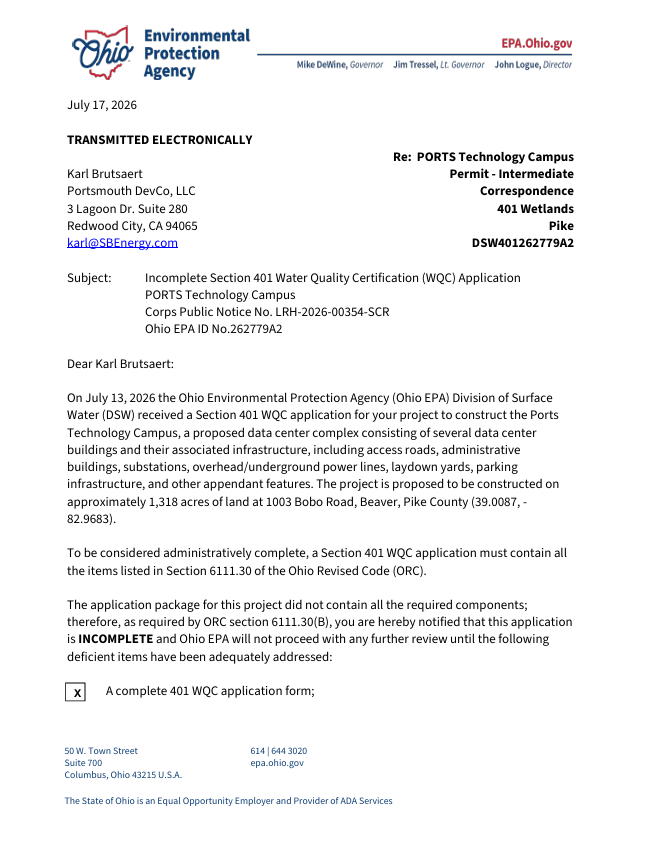
PIKETON, Ohio - The Ohio Environmental Protection Agency has determined that the Clean Water Act Section 401 Water Quality Certification application for the proposed PORTS Technology Campus in Pike County is incomplete, delaying further review until additional required information is submitted.
The Ohio EPA Division of Surface Water notified Portsmouth DevCo, LLC, in a July 17 correspondence that the agency cannot continue its review of the application until the company provides missing documentation and addresses several deficiencies identified by regulators.
The application, submitted to Ohio EPA on July 13, seeks approval under the state’s Section 401 Water Quality Certification program, which evaluates whether projects requiring federal permits will comply with state water quality standards.
The proposed PORTS Technology Campus includes multiple data center buildings and related infrastructure.
The project is proposed on approximately 1,318 acres of the former Piketon Atomic Plant, with alternative locations on farmland near, but not on the current PORTS reserve.
According to Ohio EPA Environmental Supervisor Rachel Secrest, the application did not contain all components required under Ohio law.
“Therefore, as required by ORC section 6111.30(B), you are hereby notified that this application is INCOMPLETE and Ohio EPA will not proceed with any further review until the following deficient items have been adequately addressed,” Secrest wrote.
Ohio EPA Identifies Missing Information
The agency identified multiple deficiencies within the submitted application, including missing environmental documentation and additional information needed to evaluate potential impacts to wetlands, streams, and other aquatic resources.
Among the items Ohio EPA requested:
A complete Section 401 Water Quality Certification application form.
Current documentation from the U.S. Army Corps of Engineers identifying the jurisdictional status of waters located within the project area.
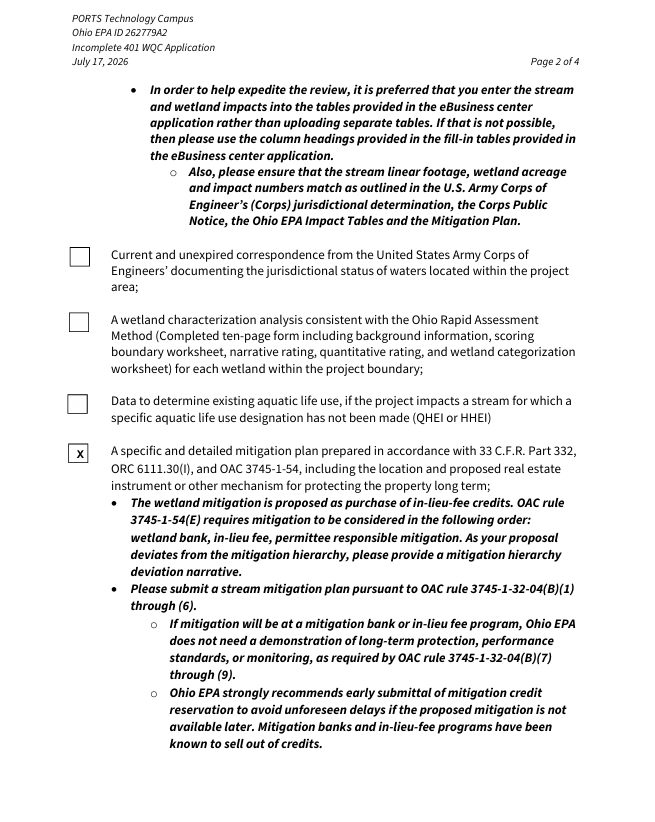
Completed Ohio Rapid Assessment Method (ORAM) wetland characterization forms for each wetland located within the project boundary.
Information needed to determine existing aquatic life uses for streams impacted by the project, where specific designations have not been established.
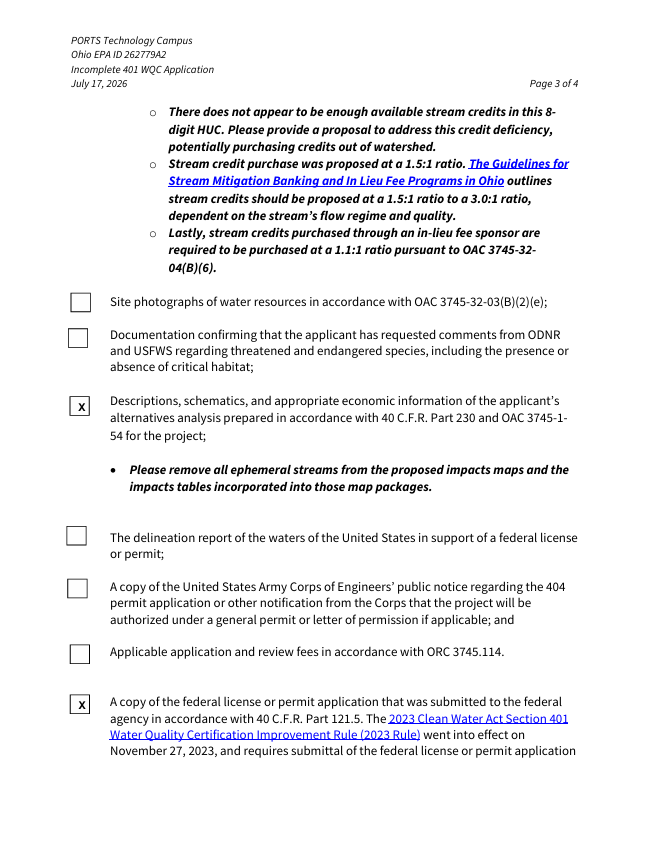
Site photographs documenting water resources affected by the project.
Documentation confirming requests for review and comments from the Ohio Department of Natural Resources and the U.S. Fish and Wildlife Service regarding threatened and endangered species and critical habitat.
A detailed alternatives analysis as required under federal and state regulations.
A copy of the federal permit application submitted to the appropriate federal agency.
Applicable state application and review fees.
The Ohio EPA also instructed the applicant to update project impact maps and tables by removing ephemeral streams from the proposed impact documentation.
Mitigation Plan Questions Raised
The agency also requested additional information regarding the project’s proposed mitigation plan.
Portsmouth DevCo proposed using wetland mitigation credits through an in-lieu fee program. The Ohio EPA noted that the proposal differs from the state’s mitigation hierarchy, which requires consideration of mitigation options in the following order:
Wetland bank mitigation
In-lieu fee mitigation;
Permittee-responsible mitigation.
Because the proposal uses an in-lieu fee approach, Ohio EPA requested a written explanation describing why the project does not follow the preferred mitigation hierarchy.
The agency also requested a stream mitigation plan and raised concerns regarding the availability of stream mitigation credits within the project’s watershed.
“There does not appear to be enough available stream credits in this 8-digit HUC,” Ohio EPA stated, requesting a proposal for addressing the potential shortage, including the possibility of purchasing credits outside the watershed.
The agency further noted that stream mitigation credits proposed at a 1.5-to-1 ratio may require adjustment depending on stream conditions and applicable mitigation requirements.
Corps Permit Review Connected to Certification
The Section 401 certification process is connected to federal permitting requirements under the Clean Water Act.
The project is also associated with review by the U.S. Army Corps of Engineers, which oversees federal permitting involving impacts to waters of the United States, including wetlands and streams.
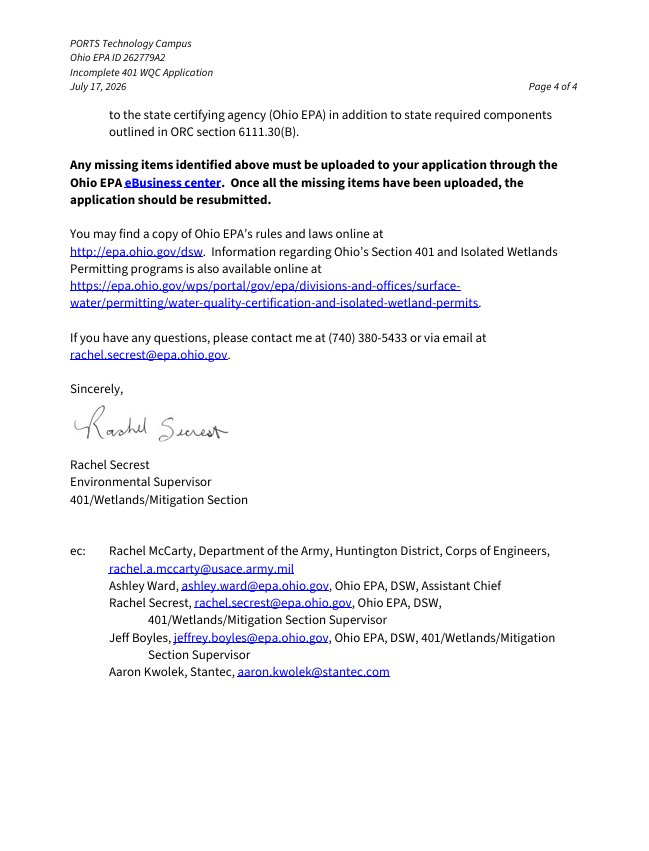
The Ohio EPA stated that federal rules require applicants to submit a copy of their federal permit application to the state certifying agency, along with the required state documentation.
What Happens Next
The Ohio EPA’s determination does not represent a denial of the proposed PORTS Technology Campus.
Instead, the agency has found the current application incomplete and will not continue its review until the missing information is submitted.
The proposed PORTS Technology Campus has drawn international attention because of its potential economic impact and the scale of the planned development. Project supporters have estimated that the construction phase could involve approximately 35,000 temporary jobs associated with building the data center complex and related infrastructure.
The development proposal also includes significant energy infrastructure, including a proposed natural gas-powered facility that project officials have described as potentially among the largest of its kind in the world.
The project has also prompted broader discussions surrounding water resources, infrastructure demands, environmental permitting, and legacy contamination concerns associated with both large-scale data center development and the former Portsmouth Gaseous Diffusion Plant site.